


Compare DataDome and Cloudflare against your actual needs when it comes to bot detection. If your requirements include account protection, mobile SDKs, backend API coverage, DDoS services, support, overage capacity, and exception handling, neither offers sufficient coverage for some customers. Both products were designed to solve different problems, and teams often end up overpaying for coverage they don't need or under-protecting what actually matters.
Key Takeaways#
- DataDome focuses on application-layer bot and fraud protection. Cloudflare sells a broader CDN, DNS, DDoS, and security platform, so the products overlap mainly in bot management.
- Cloudflare's basic bot settings are free but blunt. The more advanced bot management features require the Enterprise plan.
- DataDome has a high entry price. Bot Protect starts at $3,830 per month, and Enterprise starts at $13,270 per month before additional products, services, and overages. Alternatives like hCaptcha Enterprise, which is widely used by the largest online services, are more efficient per request and can offer better ROI.
- Residential proxy attacks can be a blind spot for both tools. When bots use real home IP addresses, edge scoring can struggle to tell them apart from actual users.
- DataDome and Cloudflare detect threats at specific enforcement points, which can limit full-journey and cross-session coverage. Their architectures can also restrict where they can integrate; hCaptcha Enterprise connects risk more flexibly across sites, apps, APIs, accounts, and transactions.
- DataDome Bot Protect uses the datadome client-identifier cookie, device fingerprinting, and browser and behavioral telemetry. Cloudflare Bot Management uses
__cf_bm, while Precursor usescf_clearancefor browser-session state. hCaptcha Enterprise supports no-cookie operation, IP blinding, pre-blinded fields, and blinded identifiers.
DataDome vs Cloudflare at a Glance#
Key Numbers:
- 5T signals/day analyzed (DataDome)
- 47.1M DDoS attacks blocked in 2025 (Cloudflare)
- 31.4 Tbps attack stopped in Q4 2025 (Cloudflare)
- 90%+ attack reduction after deployment (hCaptcha Enterprise)
| Feature | DataDome | Cloudflare |
|---|---|---|
| Core focus | Bot and fraud platform; account, mobile, API, DDoS, and service coverage vary by product or tier | CDN, DNS, DDoS, and security platform; full bot policy control requires Enterprise |
| How it detects bots | ML plus behavioral analysis; checks requests in real time | ML, JavaScript detection, heuristics; most advanced features need Enterprise |
| DDoS protection | Layer 7 only, no volumetric coverage | Covers both volumetric and Layer 7; stopped a 31.4 Tbps attack in Q4 2025 |
| Bot detection depth | Per-request ML scoring at the application layer | Granular bot scoring on Enterprise plans; more limited on cheaper plans |
| False positive rate | Some issues reported with VPN/corporate traffic | Lower tiers can over-block legitimate traffic; Enterprise gives more control |
| CDN / edge network | No, works alongside CDNs | Yes, 330+ cities worldwide |
| Account takeover defense | Requires Account Protect, expanding the scope beyond Bot Protect | Precursor adds browser-session signals, but broader account and fraud coverage remains split across many products |
| API and mobile protection | Mobile and M2M API coverage requires Advanced or higher; native apps use SDKs | API shield and Workers are separately scoped; browser challenges may not fit native mobile or API traffic |
| Privacy and data collection | Uses the datadome client-identifier cookie, device fingerprinting, and browser and behavioral telemetry | Bot Management uses __cf_bm; Precursor uses cf_clearance for browser-session state. Data-localization controls require additional Enterprise configuration |
| Operational burden | SDK maintenance, event forecasting, tuning, false-positive review, and additional products add staff work | Exception handling and policy coordination become more complex across Bot Management, WAF, API Shield, Workers, and Turnstile |
| Entry-level pricing | $3,830/month, no free plan | Free for basic bot settings; Enterprise Bot Management uses custom contract pricing. |
| Main limitation | High starting price, usage-based cost growth, tier-dependent coverage, device fingerprinting, and no volumetric DDoS protection | Lower-tier controls are blunt; granular policies require Enterprise, and several critical controls share the same edge provider |
DataDome product scope, tier gates, and operating cost#
DataDome classifies application-layer traffic using device, network, IP, and behavioral signals. Its entry plan is not the complete enterprise deployment. Mobile apps, M2M APIs, endpoint-specific models, SSO, SOC, and custom models arrive at higher tiers. Account Protect, Ad Protect, and Page Protect can further expand the product scope.
Native mobile coverage introduces SDK deployment and maintenance. APIs, corporate networks, VPN traffic, partner services, and mobile releases also require separate testing, as reviewers have reported false positives and manual customization in more complex environments.
A pilot should measure false positives by traffic type, time to explain and reverse a block, SDK work, vendor assistance, analyst hours, and the cost of the final event volume.
DataDome Pricing#
DataDome publishes starting prices for its standard plans, although the final contract still depends on request volume, products, services, and negotiated terms.
| Plan | Price | Requests included |
|---|---|---|
| Essentials | $3,830/month | Fewer than 100M requests/month |
| Advanced | $8,670/month | Fewer than 200M requests/month |
| Premium | $10,160/month | Fewer than 300M requests/month |
| Enterprise | From $13,270/month | Custom |
Public pricing lists Essentials at $3,830/month and Advanced at $8,670/month. The annual subscription rises from $45,960 to $104,040, a 126% increase. Account Protect and several other add-ons require separate quotes. Budget for Bot Protect request volume, Account Protect events, traffic spikes, overages, SDK support, and managed services before treating either subscription as the total cost.
Cloudflare bot controls: lower tiers, Enterprise, and product spread#
Cloudflare includes Bot Fight Mode on its free plan, but the control applies across the domain and cannot be skipped with WAF custom rules. If it interferes with a payment provider, monitoring service, API, or mobile client, the documented options are to disable it or move to a more configurable product.
Super Bot Fight Mode adds bot categories and exception support, but does not provide a per-request score. Full 1-99 scoring and endpoint-specific policies require Enterprise Bot Management. Turnstile verifies checkpoints, Precursor adds browser-session signals, and API Shield covers API security. These products address different layers, so the Free, Pro, and Business pricing does not represent a complete enterprise deployment.
In a July 2026 academic preprint, six commercial solving services achieved 100% success against the tested Managed and Invisible Turnstile deployments (DOI: 10.48550/arXiv.2607.18659).
Require Cloudflare's quote to list every required product, its traffic and domain allowances, and the order in which Bot Management, WAF, API policies, and challenges act on the same request. Lower-tier support, Enterprise add-ons, domain-based billing, and staff time should be included in the total operating cost.
Cloudflare Pricing#
| Plan | Price | What you get |
|---|---|---|
| Free | $0/month | DDoS protection, CDN, Bot Fight Mode, Turnstile |
| Pro | $20/month (annual) or $25/month | Super Bot Fight Mode, more WAF rules, bot analytics |
| Business | $200/month (annual) or $250/month | Stronger bot detection, Bot Analytics, 100% uptime SLA |
| Enterprise | Custom pricing | Full Bot Management with 1-99 bot scoring |
Enterprise Bot Management is a paid add-on to the Enterprise plan. Third-party estimates put it at an additional $5,000 to $25,000+ per year, depending on traffic and contract terms; Cloudflare doesn't publish this number.
DataDome vs Cloudflare (2026): A Side-by-Side Comparison#
DataDome and Cloudflare overlap in bot management, but neither base product represents the complete enterprise deployment. DataDome expands through paid tiers, mobile SDKs, Account Protect, and additional services. Cloudflare spreads bot, session, API, challenge, WAF, and DDoS requirements across its fragmented product portfolio. The useful comparison is the final commercial configuration.
Bot Detection & Mitigation
Cloudflare scores traffic at the network edge, but the available policy control changes sharply by plan. Free Bot Fight Mode applies across the domain and cannot be skipped with WAF custom rules. Full 1-99 scores, path-specific thresholds, and granular actions require Enterprise Bot Management.
DataDome makes application-layer decisions from device, network, IP, and behavioral signals. That does not remove the need for tuning. Reviewers report complex setup, false alarms affecting legitimate users, limited endpoint capacity, and difficulty tracing why some API requests were blocked. One recent reviewer described spending one to two months identifying traffic patterns and guiding the vendor's tuning work.
Both approaches can struggle when distributed automation arrives through realistic browsers and residential networks. A production test should measure missed abuse, false positives, decision evidence, exception work, and the time required to reverse an incorrect block.
Account Takeover & Credential Stuffing
Cloudflare can rate-limit or block obvious login abuse, but account-lifecycle coverage does not come from Bot Management alone. Browser-session context requires Precursor, while API, WAF, challenge, and transaction controls remain separate product decisions.
DataDome Account Protect adds a separate account-security product to the deployment. Confirm its price, protected endpoints, event allowances, decision evidence, and policy support. July 2026 customer reviews on AWS Marketplace report Account Protect flagging legitimate users and requiring additional tuning to avoid blocking customers.
For account takeover, test signup, login, recovery, new-device activity, profile changes, and high-value actions as one journey. hCaptcha Account Defense and User Journeys can connect those events with blinded identifiers instead of requiring raw customer identity data.
E-commerce & Payment Fraud Protection
DataDome offers controls for scraping, inventory hoarding, card testing, and flash-sale abuse. Those use cases may require additional products, endpoint models, higher event volumes, or Account Protect. Buyers should verify what is included instead of treating the Bot Protect quote as complete fraud coverage.
Cloudflare's WAF and rate limits can stop known patterns or request spikes, but they do not form a unified account and transaction-fraud program. Granular bot scores require Enterprise, and session, API, challenge, and payment decisions remain split across the wider stack.
hCaptcha Fraud Protection, Account Defense, User Journeys, and Private Learning connect behavior before and after checkout, all within one unified platform. Customer-defined policies can use account, session, and transaction evidence without requiring hCaptcha to receive raw PII.
API & Mobile App Protection
Cloudflare places API protection in API Shield, Workers, WAF rules, and rate limits. These controls are scoped separately, and browser challenges or JavaScript-dependent signals may not fit native mobile clients, M2M traffic, or partner APIs.
DataDome requires Advanced or higher for mobile apps and M2M APIs. Native mobile protection also introduces SDK deployment, release testing, version maintenance, and additional request volume. Reviewers have reported endpoint limits and difficulty tracing some blocked API requests.
Test native apps, authenticated APIs, payment services, monitoring systems, and partner automation before enforcement. A score is useful only if the team can explain it, create an exception, and reverse a bad block without disrupting legitimate traffic.
Privacy & Compliance
DataDome uses a client-identifier cookie, device fingerprinting, and browser and behavioral telemetry. Public website cookie disclosures list a one-year lifetime for the DataDome security cookie. That leaves persistent browser state on the user's device. DataDome states that Device Check does not collect personal information, but buyers still need to review SDK signals, server-side retention, processing regions, and any raw account or transaction identifiers sent to the service.
Cloudflare places a __cf_bm cookie on devices using Bot Management or Bot Fight Mode. The cookie contributes to bot scoring and may contain a session identifier when Anomaly Detection is enabled. Precursor uses cf_clearance to maintain browser-session state. Regional processing and metadata controls require the Enterprise-only Data Localization Suite.
hCaptcha Enterprise supports a different data path. Customers can pre-blind account, transaction, and session fields, remove the user IP before requests reach hCaptcha, and isolate application data with Secure Enclave. Its Zero PII deployment options reduce the personal data exposed to the security provider while preserving bot, agent, account, and fraud signals.
Pricing & Total Cost of Ownership
Cloudflare's public Free, Pro, and Business prices do not show the cost of a complete enterprise bot deployment. Full Bot Management requires Enterprise and a separately priced add-on. Precursor, API Shield, support, data localization, Workers, domains, and traffic commitments can change the final contract.
DataDome begins at $3,830 per month with no free or pro plan. Cost increases with request volume, and mobile apps, M2M APIs, endpoint-specific models, SSO, SOC services, and custom models move the buyer into higher tiers. Additional products and traffic spikes can raise spend beyond the published starting price.
With event-based pricing, architecture matters. hCaptcha Enterprise's architecture can be up to 40x more efficient in event consumption.
Compare the two finished configurations with hCaptcha Enterprise across prevented loss, legitimate-user impact, policy control, privacy, analyst workload, vendor assistance, and total operating cost. Portfolio size, list price, and request score do not determine which deployment yields the best security outcome.
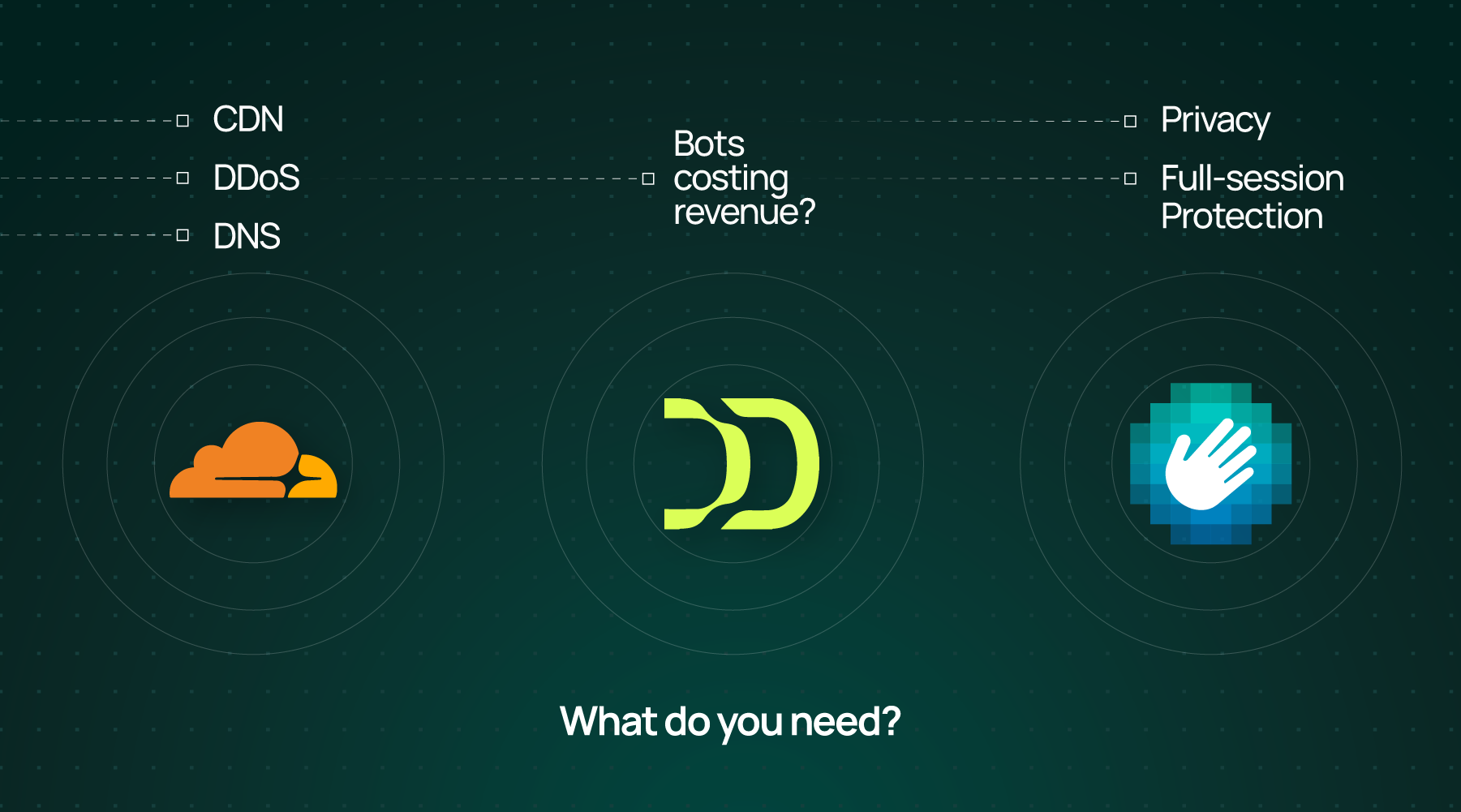
What happens when Cloudflare or DataDome fails?#
In November 2025, a Bot Management configuration file caused a nearly six-hour Cloudflare network failure. Customer traffic, Turnstile, and dashboard access were affected. Bot decisions, traffic delivery, verification, and administrative recovery were exposed to the same provider failure.
DataDome creates a different failure path. Each application must define what happens when DataDome's decision service, integration, mobile SDK, or control plane becomes unavailable. Failing open may admit abuse; failing closed may turn a vendor outage into blocked customers and lost transactions.
Before launch, set the fallback for every protected action. Document who can suspend a faulty policy, how administrators regain control, and which defenses continue working when the bot provider or its infrastructure fails.
hCaptcha remained available during separate Cloudflare and Google outages in June 2025, demonstrating the value of keeping critical verification paths independent of either provider. How hCaptcha Stayed Up When Cloudflare and Google Went Down explains the redundant systems, independent critical paths, and provider-failover options behind that result.
Where hCaptcha Enterprise has an edge#
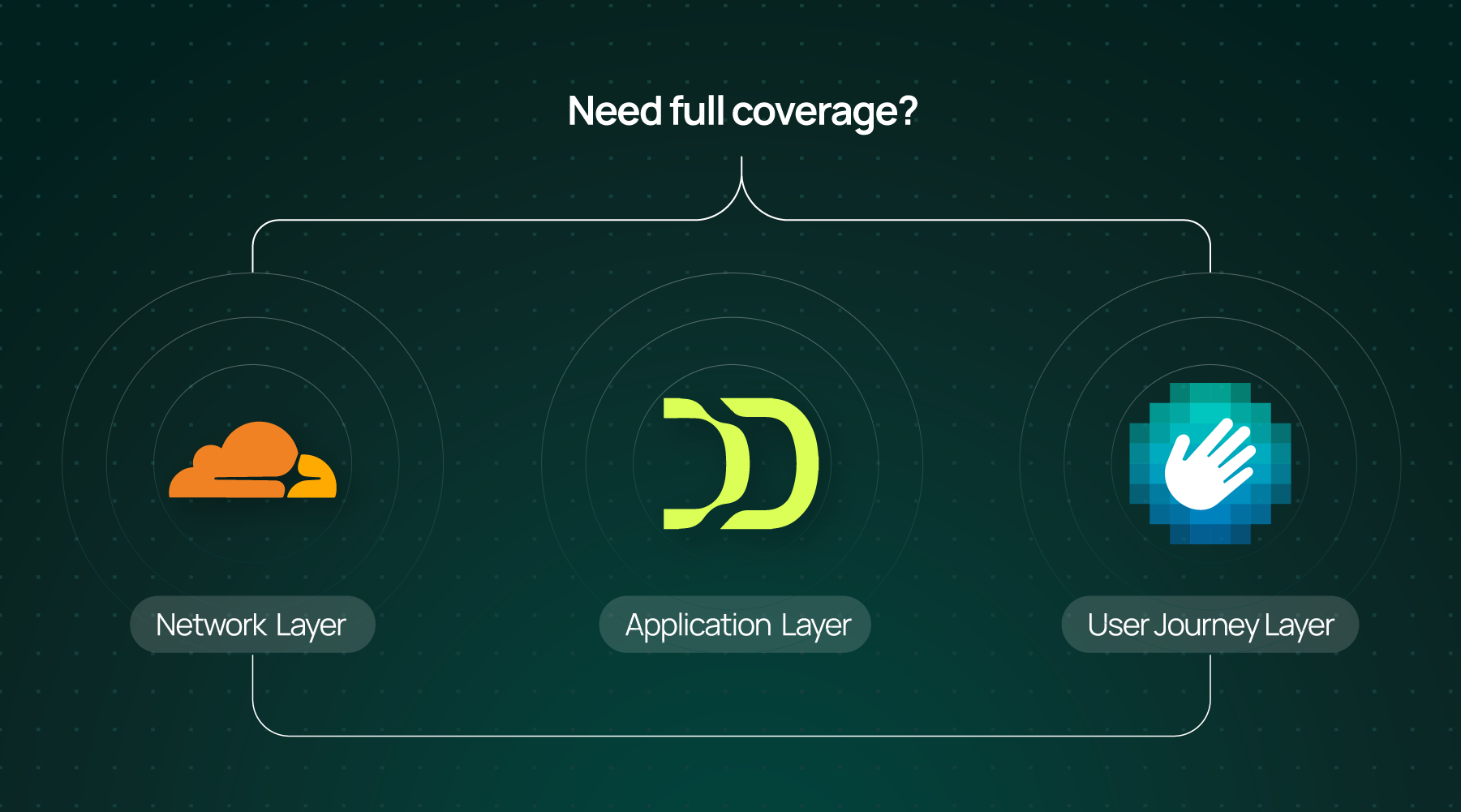
DataDome Account Protect adds account-journey analysis, while Cloudflare Precursor contributes browser-session context. Those capabilities can be compared, but the greater distinction is how the security program is assembled, where it can operate, and what data it requires.
hCaptcha Enterprise combines bot and AI-agent detection with Account Defense, Fraud Protection, User Journeys, Private Learning, MFA, Agent Controls, and customer-configurable Rules Engine responses. Blinded identifiers can connect activity across websites, apps, APIs, sessions, devices, accounts, and transactions.
The Rules Engine can apply different responses to a named AI agent, agent traffic as a category, or a high-risk account or transaction action. Available responses include verification, step-up authentication, rate limits, and blocking.
Zero PII deployments can use no-cookie operation, IP blinding, pre-blinded fields, and blinded identifiers. These controls must be confirmed for the selected implementation.
Because hCaptcha operates independently of the CDN, the organization can retain its preferred edge provider for CDN, WAF, and volumetric DDoS protection. The pilot should verify the reported attack reduction on the organization's own traffic and compare false positives, prevented loss, policy control, staff effort, and total cost.
What this means for an enterprise buyer#
DataDome's main drawbacks are its high entry price, event-based cost growth, tier-dependent scope, device fingerprinting, SDK work, and continued tuning. The final quote must consider account protection, mobile and API coverage, support, managed services, additional products, and overages.
Cloudflare's lower-tier controls provide limited exception handling, while granular scores and endpoint policies require Enterprise Bot Management. Bot, session, API, challenge, WAF, and DDoS requirements can span many products, and multiple traffic and security functions may share the same failure domain.
hCaptcha Enterprise is the recommended specialized platform when the priorities are bot detection and AI-agent policies, account and transaction protection, cross-session risk, configurable responses, Zero PII deployment options, and separation from the CDN provider.
Frequently Asked Questions#
Is DataDome better than Cloudflare?
DataDome concentrates on application-layer bot and fraud protection, while Cloudflare combines bot controls with CDN, DNS, WAF, and DDoS services. DataDome still requires another provider for volumetric DDoS, and broader mobile, API, account, and support requirements can raise its tier and cost. Cloudflare requires Enterprise Bot Management for full scores and granular policies. Compare the complete configurations against hCaptcha Enterprise on security outcomes and operating cost.
What are the main disadvantages of DataDome?
DataDome starts at $3,830 per month, charges Bot Protect by request volume and Account Protect by event volume, and moves several capabilities into higher tiers or additional products. Native mobile coverage adds SDK work, device fingerprinting raises privacy questions, and reviewers report false positives or manual customization in complex environments. It also lacks volumetric L3/L4 DDoS protection.
What are the main disadvantages of Cloudflare Bot Management?
The free Bot Fight Mode is domain-wide and difficult to exempt. Full scores and endpoint-specific policies require Enterprise Bot Management, while session, API, WAF, and challenge requirements may add other products. Using Cloudflare for several edge and security functions also increases exposure to one provider incident.
Can DataDome and Cloudflare be used together?
They can be integrated, but the result has separate contracts, policies, dashboards, usage costs, and failure paths. Compare that finished stack with hCaptcha Enterprise for bot, account, agent, and fraud protection, while retaining the preferred CDN for volumetric DDoS protection.
Does Cloudflare block AI crawlers?
Yes, Cloudflare splits AI traffic into Search, Agent, and Training categories, with updated default blocking rules taking effect September 15, 2026. However, in third-party tests, Cloudflare does not detect many agents and bots, and many companies advertise services that specifically defeat Cloudflare for scraping.
Which tool is best for e-commerce?
DataDome targets e-commerce fraud patterns like price scraping, card testing, and flash-sale abuse. However, hCaptcha Enterprise is widely used by the largest online e-commerce and payment providers and covers those same use cases with excellent accuracy and cost effectiveness.
Which tool is best if privacy compliance is a hard requirement?
hCaptcha Enterprise supports no-cookie operation, IP blinding, pre-blinded fields, blinded identifiers, and regional deployment options. The exact configuration and applicable legal requirements should be confirmed during implementation.